Every pool owner hopes they'll never face a drowning emergency. But if it happens, what you do in the first few minutes matters. Starting CPR quickly and calling for help early give the person the best chance.
This guide explains the basic life support action plan used in Australia, the CPR signs some states require, what to keep near the pool and how to get trained. It is general information based on guidelines from the Australian and New Zealand Committee on Resuscitation (ANZCOR) and is not a substitute for hands-on training. Please complete an accredited first aid or CPR course and refresh it regularly.
The DRSABCD action plan
ANZCOR's basic life support flowchart uses the steps DRSABCD:
- D - Danger. Check for danger to yourself, bystanders and the person. Don't become a second victim.
- R - Response. Check if the person is responsive. Talk to them and squeeze their shoulders.
- S - Send for help. Call Triple Zero (000), or ask someone else to call.
- A - Airway. Open the mouth and check the airway is clear. If there is foreign material, roll the person onto their side to clear it.
- B - Breathing. Check for normal breathing by looking, listening and feeling.
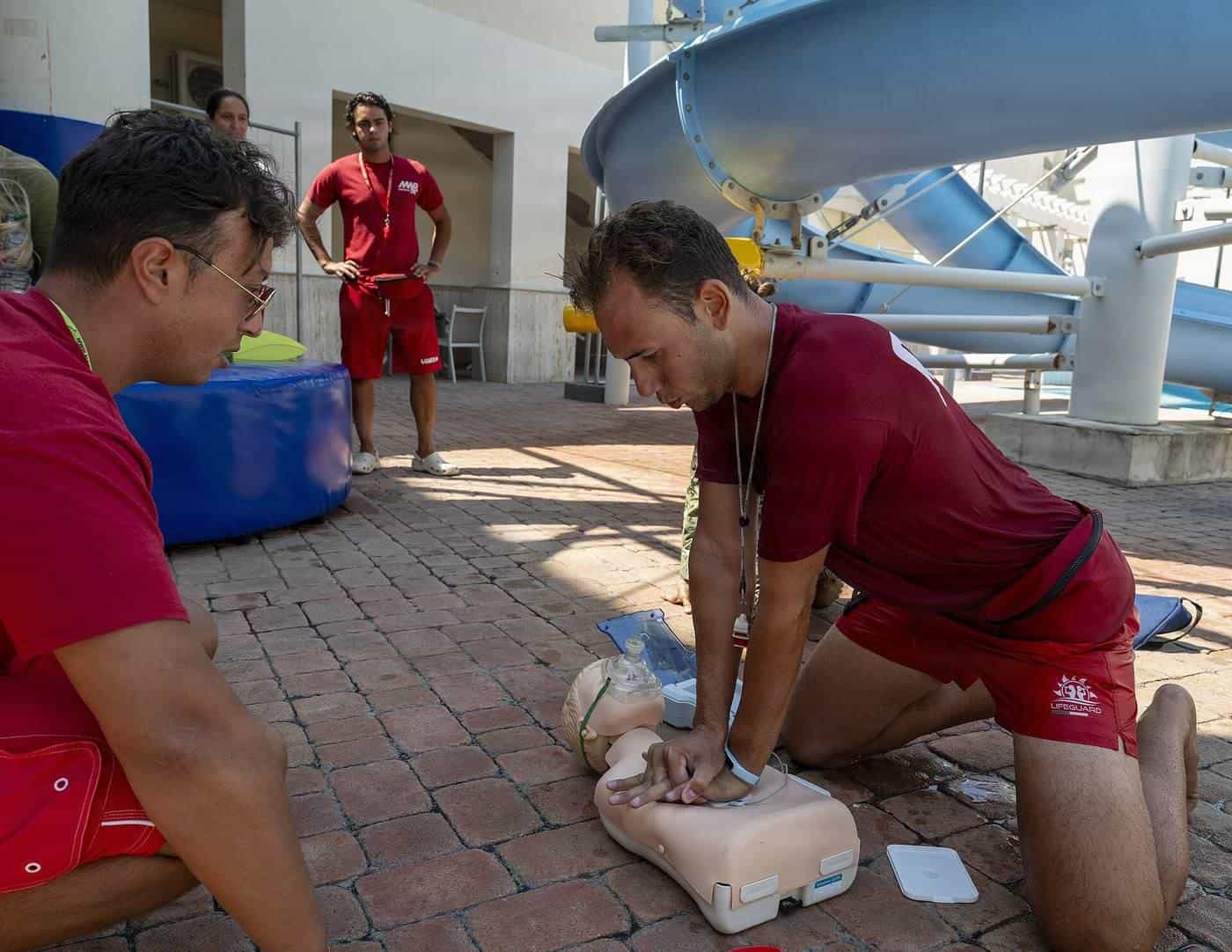
- C - CPR. If the person isn't breathing normally, start CPR: 30 chest compressions then 2 breaths.
- D - Defibrillation. Attach an automated external defibrillator (AED) as soon as one is available and follow its prompts.
30:2
Compressions to breaths
ANZCOR guideline for all ages
100–120
Compressions per minute
Push hard and fast
000
Triple Zero
Call for help early
CPR basics
ANZCOR guidelines recommend:
- 30 compressions to 2 breaths for all ages;
- a compression rate of 100 to 120 per minute;
- compressions on the lower half of the breastbone, pressing down about one third of the depth of the chest, letting the chest recoil fully between compressions;
- minimising interruptions.
For infants, the technique differs (for example, using two fingers for compressions). This is one reason why hands-on training is so important.
If you can't or won't give breaths, continuous chest compressions are better than no CPR. Keep going until the person shows signs of life, a trained person takes over, or it becomes impossible to continue.
Calling Triple Zero
Call 000 as early as possible. If you are alone, put the phone on speaker beside you so the operator can guide you while you do CPR. Know your address, including the nearest cross street, so you can give it quickly. If you have a mobile with no coverage, 112 may connect you.
CPR signs
Several states require a resuscitation sign or warning notice at home pools. For example:
- New South Wales requires a warning notice with resuscitation instructions to be displayed near the pool.
- Queensland requires a compliant CPR sign to be displayed near a regulated pool.
Requirements differ elsewhere. Even where it isn't required, a clear, current CPR sign is a useful reminder for visitors and babysitters. Check that it:
- reflects current ANZCOR guidelines;
- is easily visible from the pool;
- is in good condition, not faded or damaged.
What to keep near the pool
- A phone, charged, so you can call for help without leaving.
- A first aid kit, stocked and checked regularly.
- Your address written near the phone or on the CPR sign, for visitors.
- A reaching aid, such as a pole or flotation device, to help someone in difficulty without getting in the water yourself where possible.
- Knowledge of the nearest AED. Some community AEDs are registered on public apps or maps.
Getting trained
Look for a nationally recognised first aid or CPR course from a registered training organisation. Many organisations offer courses, including Royal Life Saving, St John Ambulance, the Australian Red Cross and Surf Life Saving, as well as private providers. Courses cover adult, child and infant CPR, recovery position and other first aid.
Skills fade over time. Many providers recommend refreshing CPR training every year.
After an emergency
Even if a person seems to recover after being pulled from the water, they should be assessed by paramedics or a doctor, because complications can develop later. Ambulance officers will advise.
It's also normal to feel shaken after an emergency. Support is available through your GP and services such as Lifeline (13 11 14).
Pool chemical first aid
Pool chemicals are another hazard. Store them safely, away from children, in original containers and as the label directs. If someone swallows a chemical, gets it in their eyes or breathes in fumes, call the Poisons Information Centre on 13 11 26 for advice, or 000 in an emergency. Keep the product label handy so you can describe it.
Be prepared
0 of 9 done
Ticks are saved in this browser only.
Making an emergency plan for your household
Knowing CPR is one part of being prepared. The other part is a plan that everyone in the household understands before anything goes wrong.
- Know your address. Make sure everyone, including older children and regular babysitters, can give your full street address and nearest cross street to the Triple Zero operator.
- Keep a phone near the pool. A charged mobile phone within reach saves precious seconds. Triple Zero calls can be made from any mobile phone.
- Know where the first aid kit is. Keep it in the same, easy-to-reach place, and restock it after use.
- Agree on roles. At gatherings, decide in advance who will watch the water, who will call for help and who is trained to start CPR.
- Share the plan with visitors. Grandparents, carers and friends who look after your children should know where the phone, kit and CPR sign are.
Revisit the plan each spring, when you check your pool barrier and refresh your CPR training.
Common mistakes
- Waiting to see whether a person recovers before calling Triple Zero.
- Assuming a weak swimmer will splash or call out. Drowning is often quiet.
- Letting CPR skills lapse for years without a refresher.
- Keeping a faded or outdated CPR sign that no longer matches current guidelines.
Key points
Follow the DRSABCD action plan: check for danger, check response, send for help by calling 000, open the airway, check breathing, start CPR at 30 compressions to 2 breaths at 100 to 120 compressions per minute, and use a defibrillator as soon as possible. Some states, including NSW and Queensland, require CPR signs at home pools. Get accredited training, refresh it regularly, and keep a phone, first aid kit and your address near the pool.
Related guides
Read keeping kids safe around pools, pool fencing rules and pool water chemistry basics.
Frequently asked questions
What is DRSABCD?
DRSABCD is the basic life support action plan used in Australia. It stands for Danger, Response, Send for help, Airway, Breathing, CPR and Defibrillation. It is set out in guidelines from the Australian and New Zealand Committee on Resuscitation (ANZCOR).
What is the CPR ratio in Australia?
ANZCOR guidelines recommend 30 chest compressions followed by 2 breaths, at a rate of 100 to 120 compressions per minute, for all ages. If you are unable or unwilling to give breaths, continuous compressions are better than nothing.
Do I need a CPR sign at my pool?
Several states, including New South Wales and Queensland, require a CPR sign or resuscitation warning notice for home pools. Check your state's requirements and make sure the sign is visible from the pool and readable.
Where can I learn CPR?
Accredited first aid courses are offered by registered training organisations, including organisations such as Royal Life Saving, St John Ambulance, the Australian Red Cross and Surf Life Saving. Look for a nationally recognised course.
Should I call 000 before starting CPR?
Send for help as early as possible. If someone else is there, ask them to call Triple Zero (000) while you start CPR. If you are alone, call 000 on speaker phone so the operator can guide you.
Sources and further reading
Facts on this page were checked against these primary and official sources. Conditions change — confirm before you travel or buy.
- ANZCOR guidelines — Australian and New Zealand Committee on Resuscitation
- Keep Watch — Royal Life Saving Society Australia
- Swimming pools — NSW Government
- Pool safety — QBCC
- Triple Zero — Australian Government